Project
Redesigning support at Trade Me
company
Trade Me
Category
[Design]
Year
2020
Trade Me is New Zealand’s leading online marketplace and auctions website, created in 1998. Trade Me’s help centre was built at the same time as the website and encompassed over 500 articles to solve common customer problems. There was no clear direction or structure on how these articles were to be shown, and no customers had ever been contacted to know if they were effective or not. We had long wait times and 3 different support channels to fill the needs of our customers. In 2018, we decided to focus on a big project to rethink all our help content, and move it to a platform that would be easy for both our customers and users (internal teams) to navigate. We had a few rounds of research to understand what our customers wanted from support and our developers had the challenge to spend 2 weeks investigating multiple support platform solutions to know which one would be best for us.

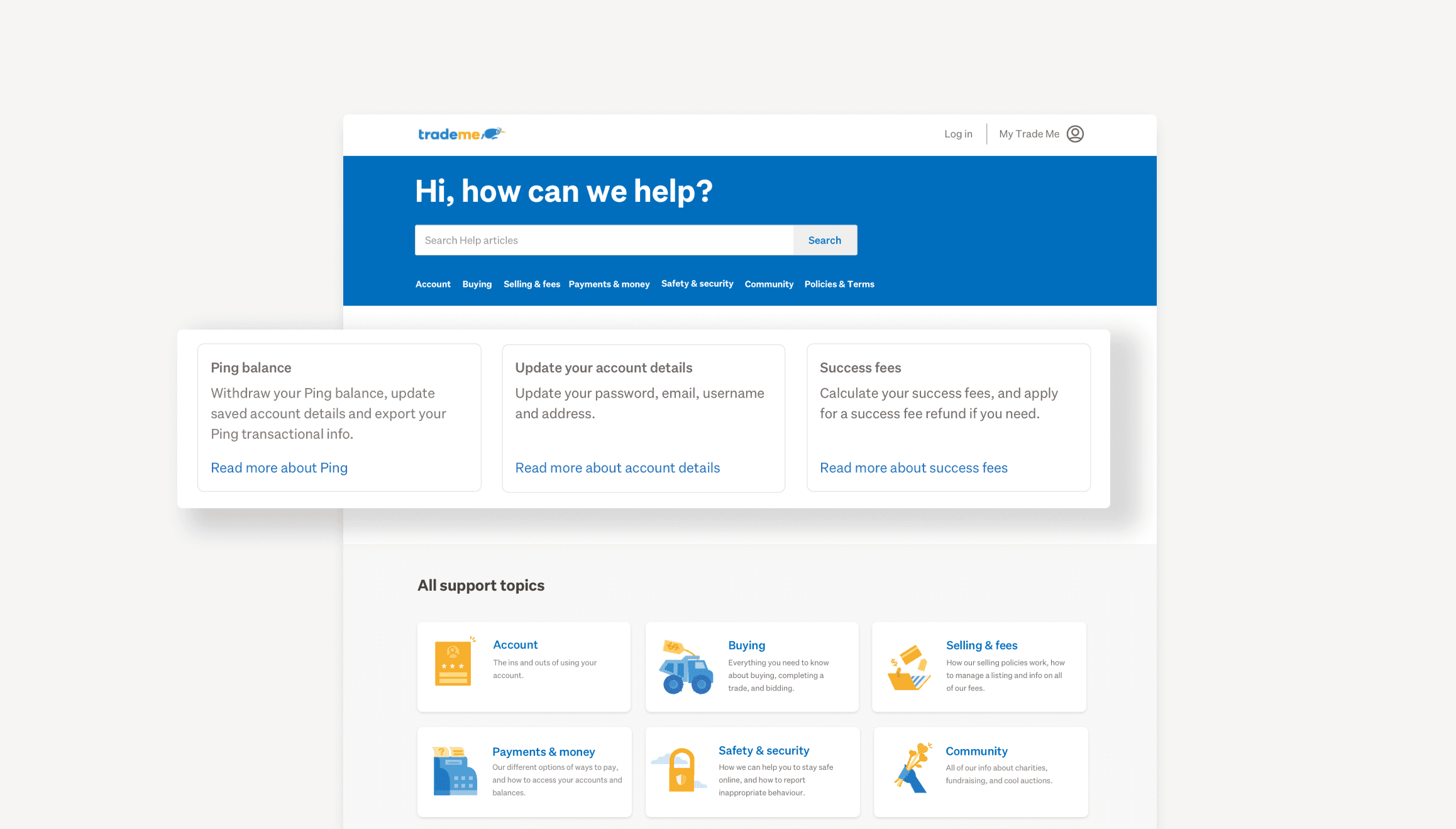
After a couple of weeks exploring different knowledge base platforms, we decided to use Zendesk as it seemed to be the most intuitive for our customers and users. Having a platform that offered support solutions out of the box worked really well for us, since it removed the need to build and maintain it from scratch. On the other hand, using a pre-made solution means we had to make some compromises. Our design system, Tangram, was built in angular. When trying to apply it to our new Help Centre, we quickly realised we would have to choose between keeping our visual language or keeping the out of the box benefits and functionalities of Zendesk. We went ahead with the compromise, as the trade off and flexibility made it worth it. One example of the benefit of the modularity and flexibility of the Help Centre is when we had to make very fast changes to respond to COVID-19:

The Help Centre homepage is where we had the most freedom, and we had a challenge with defyining how to design it as user testing for support is not as stright forward as the other parts of the product. Support is the only part of your website where members visit not because they want, but because they need. And when the need comes from a situation of frustration because something went wrong, they’re mindset and emotions are very different from when they’re navigating the main website. It’s difficult to replicate the same situations, which has made it hard for us to get valuable insights previously. We started using our customers’ tickets to understand where they’re having problems with our product. Having an organised IA meant it was easy for us to track where they’re coming from, as well as what path they're following, and tweak our structure when necessary. This also gave us the flexibility to enable our internal Customer Support and Trust and Safety teams to decide what content should be surfaced on the homepage based on the tickets they were receiving.
An acitvity that was a part of the whole process of redesigning our help centre was workshops. Support is one of the few teams in our company that have customers as well as users. Every little change we make on the help centre interface becomes a change in process for our internal customer experience and trust and safety teams, so we knew we needed to bring them along with the decisions we make. We’ve found that having workshops has been the best way to go about it. In a workshop, we can gather their fears and concerns, as well as their ideas on how to make the process better.

We launched our new Help Centre and were able to increase our reduce our customer wait time from 55 hours to 2 hours. Our self service score (ratio between the number of help page views and the number of tickets we were getting) increased from 2.3:1 to 10.8:1, which means more people were finding the answer to their issues before needing to contact our customer support team.
Josie Conijn - Sr. Product Manager Jimmy Corbishley - Engineer Jonathan Brown - Engineer Ern Wong - QA Engineer Noeli Tortul - Engineering Lead